
LIV Forever.
The top players now don’t need the grind of 45 weeks’ travel and hotel rooms, for de facto second-tier events, where they are pressured by the hamster wheel of winning ranking points.

The Albachiara Journal is an eclectic collection of our opinion and perspective, from our travels and encounters.
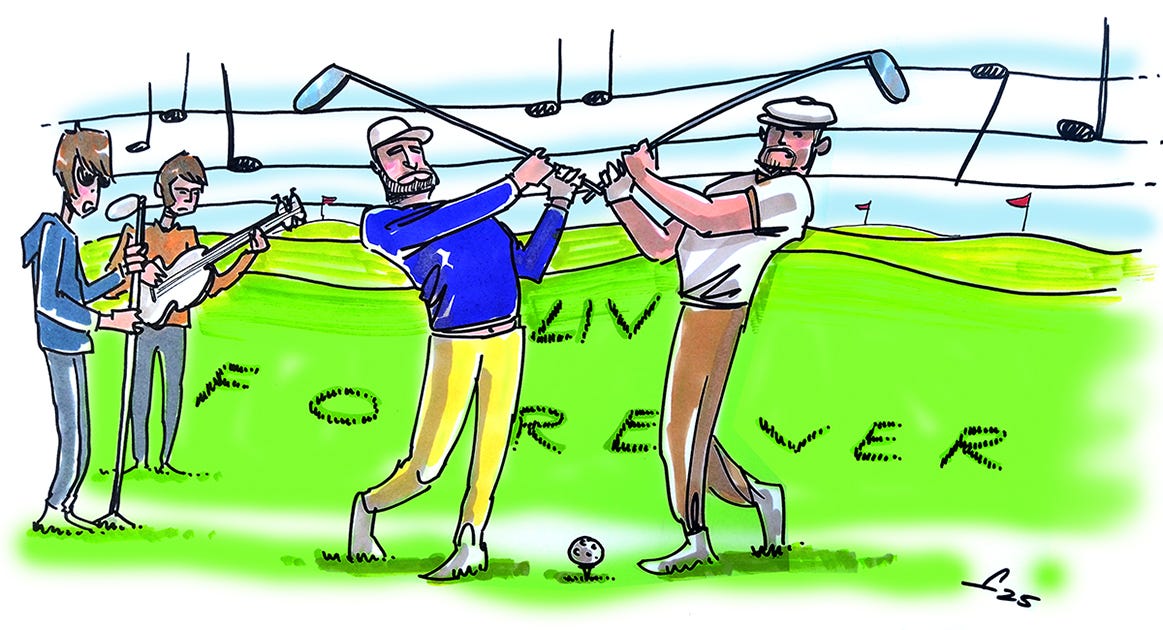
Rock music blares on the first tee, but the players hitting off don’t seem to miss a beat. Earlier on the range, a thumping backbeat accompanied the “pitlane-walk” of VIPs, surely all too close for these players going through their routines? But they’re not phased, as they hit their barely-human practice drives over 350 yards, and we all pick our jaws off the turf. They’ve got special equipment right? Surely?
It’s really a treat to be this near the talent, where everyone seems so relaxed, some huddled together in their groups of 4, pep-talking each other for the round ahead. The team element of the product offering is fresh and additive; they even have a Captain’s WhatsApp Group. The cynics will say it’s all so friendly because there is nothing really at stake for these boys.
Golf was my Dad’s game.
My mind drifts to my late father, a low-handicap member of a club in Barrhead, Scotland. He would tell me stories of following Arnold Palmer in the early 60s, and how Arnie’s drives never seemed to come down either. Explaining the mass popularity of the American, and his Army, who utterly energised a sleepy sport.
Bryson is the last to leave the range, and it’s absolutely clear that in young kids’ eyes he is now the man. He is the new Arnold Palmer. It’s not just the handsome face, the charisma, and the violence of swing, it’s that, like Palmer, he is going to change how golf now appeals, and is consumed. He is simply the product/market fit for the modern version of the sport. (I make a mental note that his contract is shortly up!)
Dad loved his golf, out in all weathers, tough competitor, fair as the day is long. Not a gifted long-game, but could scramble with the best of them. He fully embodied what many would call traditional golfing values, and was always a good judge of character. He smelt a wrong ‘un a mile away.
“If you want to know what a man is really like, go and play golf with him. He can’t fake it out there for 18 holes.”
Never a truer word. Fifty years later, I’m sat here in Valderrama, Andalusia, in the splendid LIV hospitality overlooking the 18th green, penning these opening paras on my iPad. It’s turning into a lovely day, and I realise that I am very lucky.
On previous Sundays we have covered both tennis and rugby, so it now really seems apposite, right here, to take a deep dive into a third of the British middle-class sports. Golf.
This Column is really just for my dad, about his sport.
The Gospel according to St. Luke.
For the record, I wasn’t there.
They say that the history books are written by the winners, but I am neither winner nor loser, have no dog in this fight, and was not even an eye-witness to events. I’m therefore more a St. Luke than St. John as a historian, who, through curious interview and research, now offers an honest attempt to write fairly about what actually happened.
My God, what a story this is! Much more complex and nuanced than the accepted wisdom. A story of heroes, and great deeds, names on the spoils of victory. And perhaps also of betrayals.
Truly epic stuff.
But complexity is not always seen as a virtue, and this version of the truth may anger and even disappoint many of the people I respect and call friends. They may prefer the simpler tale.
Let the golfing gods be the judge.
The signposts are always all around us.
My eye catches the young Irish golfer, Tom McKibbin, a rising star of the sport, putting-out right below me. Why has he chosen LIV? He isn’t getting a life-changing signing-on fee. Why is he throwing his lot in with the “rebels”, risking ostracisation, ranking points, and a Ryder Cup place?
Someone mentions a recent interview where he states how being part of the Jon Rahm team is so positive for him. He’s motivated to not let Jon and the other two teammates down, and sees the Spaniard as a true mentor. This is really interesting and new for what is the definitive individual sport.
I take a picture of him, in front of a brand new HSBC hoarding.
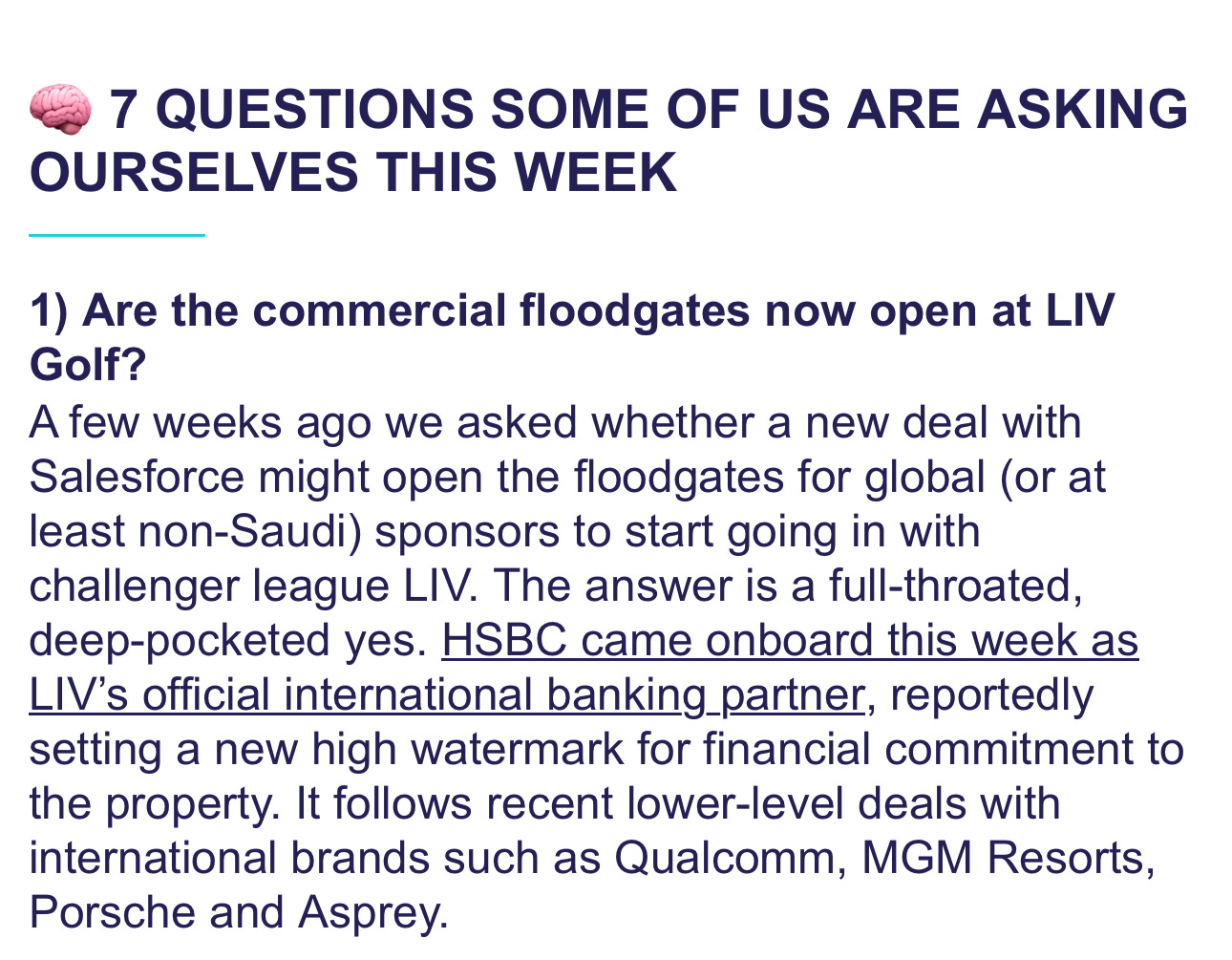
Why has the global bank finally decided to get behind LIV this very week, when so many sponsors have actively stayed away from the Saudis? In reality press-ganged to stay away! And why now?
The Leaders editorial team also noticed.
So what is really going on here?
In all wars, there is always a moment of momentum change. Is HSBC El-Alamein? Or have I already had one complimentary sangria too many?
“It’s not how, it’s how many.”
Principles and brave opinion are very expensive, especially in highly political situations, but my dad always told me to be ready to pay that price. He once resigned his golf membership because some crusty old git had chastised me for being too noisy in the dirty bar. I was 6 or 7 at the time. He gave this pedant a piece of his mind, around needing to appeal to new members, being more welcoming to youth participation, just being less anally retentive. Because, he knew he was already fighting a losing battle to win me away from football, and this old codger wasn’t helping his cause.
In some ways, he was getting an early glimpse of where golf would ultimately find itself decades later, desperately chasing younger fans, and not at all understanding why they weren’t interested. That’s a big, big part of today’s story.
I never became a keen golfer but, like any teen son, always wanted desperately to please the old man. You’d return from your own occasional game at the local municipal course, with stories of wind, bad bounces, and silly three-putts. Or in Paisley, neds stealing your ball! You’d get little sympathy in my house.
“Son, it’s not how, it’s how many.”
Again, never a truer word. Golf is a really great sport, a holistic test of who you are, but, as in life, it’s best to learn early that things aren’t necessarily fair. You don’t always get the score you deserve.
Is it for example fair how the golf establishment has categorised the good and bad guys with LIV and the Tours?
An insult to the 9/11 families.
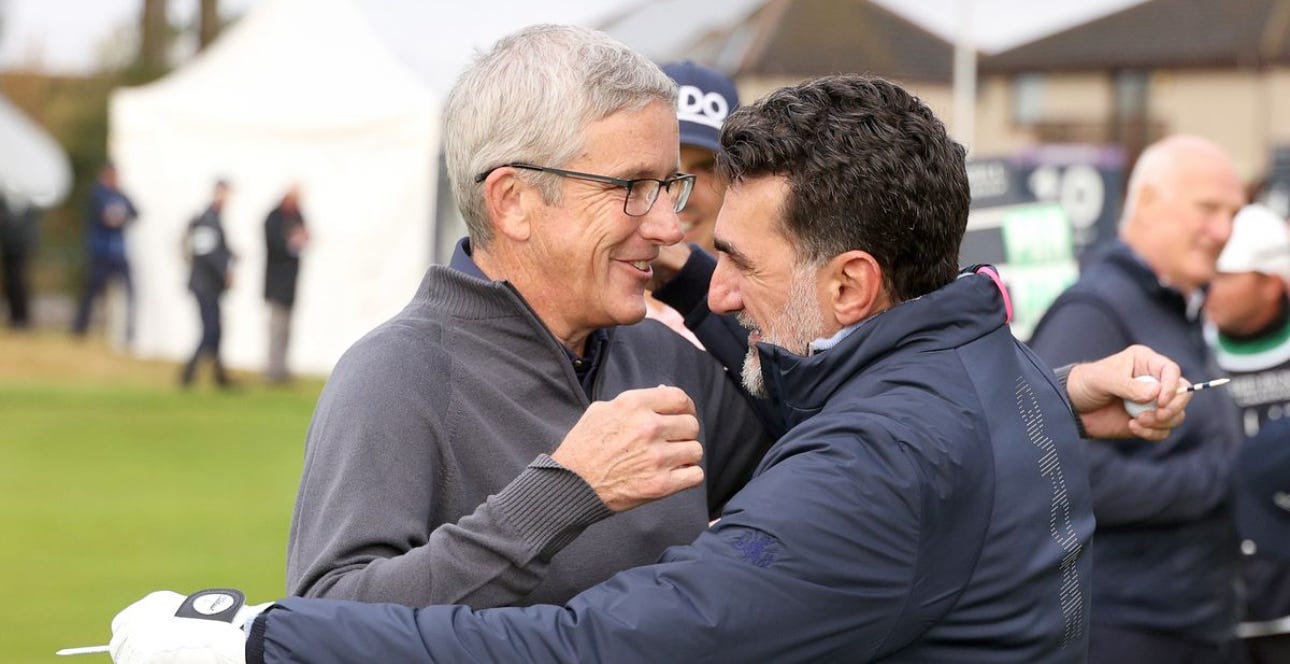
That’s how golf’s most senior administrator described LIV, financed by those Saudi Arabians. No punches pulled there, instantly claiming a very superior moral high ground. (The same person would later shamelessly sit down with them, all smiles, looking to reach a deal. So much for principles).
No, my dad wouldn’t have liked Jay Monahan.
Listen, it’s relatively easy to make the case against LIV, the one everyone knows, so let’s get it out the way early today.
[A nation state (with a nasty reputation to wash) decided to employ its unlimited resources to takeover a storied sport that has over 100 years of cherished history and etiquette. Saudi Arabia could achieve this because it had/has no obligation to create anything resembling a sustainable eco-system or financial model that works. They just used their endless price-insensitive Kashoggi blood money to bribe top players to join them, and abandon their old compatriots. All to play in a new tour of events that have no meaning, that no one cares about, that no one watches.
Unsurprisingly, those same players have banked those cheques and for three years phoned-in a lackadaisical attitude to sport and competition, where all of them have consequently lost their playing edge. No broadcaster has wanted anything to do with the TV rights for this circus, and sponsors have been similarly apathetic. LIV has failed, but in doing so, has destroyed a sport of true honour and camaraderie.]
That’s the facile pleadings for the prosecution, and this line has overwhelmingly won the comms battle. Many would say simply because it is all true.
Really? We shall see.
Today’s golf fan is just too selfish.
How you look at all this actually comes down to when you were born. And whether you really care about where the sport will be after you are gone.
The classic older demographic sees absolutely none of the problems with the game, because the status quoactually works for them very well. Nests are empty, and they now have time on their hands to commit 5/6 hours a day to playing or watching golf. They are in the armchair and slippers phase of life, counting their money, a routine broken only by the Sunday medal four-ball, the annual week-away trip with the lads to Marbella, the monthly corporate piss-up over 18 at Sunningdale. And the Golf Channel. They have disposable income, are a wee bit elitist, and definitely don’t like young riff-raff having radical ideas about their sport. They look down their nose at TopGolf and TGL.
This is the current golf customer base. And they are SORTED. They are not bad people, but are only thinking of themselves, not really worrying about the future of the sport they claim to love, and where it will be in 20 years. They couldn’t care less, and that’s somewhat disappointing I have to admit. These are the foot-soldiers who cheered on Jay Monahan and Keith Pelley when LIV came along in 2020, and are also the people who now immediately post a nasty snide tweet whenever Bryson is having a bad day,
“Show that double-bogey to your YouTube followers, De Chambeau.”
It’s stereotypical of a certain type of sport fan, who in general absolutely despises anyone trying to future-proof the sustainability of their sport, looking at innovation, seeking out fresh audiences, new formats. They don’t want any of that, and neither do the traditional golf media, who have surgically shaped the LIV narrative for them.
These “journalists” to date have clinically offered us only the PGA party line and hit pieces, as that’s what incumbent hacks always do with challenger leagues (in any sport). They will try and kill them at birth, because the last thing they all want is to lose the cosy relationships with the current power-brokers, that they have created over decades, and which give them inside scoops. On the tee, Upton Sinclair.
If we want to critique LIV Golf, and we must, at least let’s do it professionally and fairly.
Noblesse oblige.
It is today de rigeur, golfing noblesse oblige, to unconditionally despise this new challenger league. Curse the ground on which they walk. See no redeeming factors.
That’s par for the course (pun intended), in our industry.
But with all the issues golf now has – of product market fit, financial sustainability, invisible younger audiences, creaking revenue models – this is simply unkind and mean. And not intellectually impressive. But at the end of the day this is what (sport) critics do, and have always done. They are the MS-DOS users of society. Here’s instead to the crazy ones, who think different to the pack.
Crazy ones who maybe think, even for a brief moment, that LIV has actually been a very useful disruptor, who has done this old sport a very great service. The PGA has accomplished more innovation in 2 years than in the previous 100, often copying much of a vision they initially criticised in LIV.
Does no one have the kindness to concede even that?
For the record, my own sample size of one, I thoroughly enjoyed my first experience of LIV. It was a fresh vibe, full of families, women, youths, specific areas to chill out with fun activities, real proximity to the stars. With the shotgun start, it’s an event that doesn’t demand your entire day, and all that worked for me.
I saw a product that was at least aspiring to attract a modern fan, with a sense that they know they are operating within a very competitive market for the entertainment and sponsor dollar, and have to work really hard at proper customer satisfaction.
Sport forgets every bit of that all too often, taking fans for granted, soaking them mercilessly. A million different subscriptions needed, and ever-increasing ticket prices. Out-dated offerings (logos and boards) to sponsors.
Yes, I enjoyed my day, they were very kind to me, but none of that will help them with this Column.
Principles!
LIV isn’t the disease, it’s the symptom.
We’ve heard the accusations against LIV. Some are fair.
Over these three years, their vision and forecasting has been shown to be well off the mark, and anyone who doesn’t want to face into that error is equally as obtuse as the other side. In terms of a business plan, they massively overestimated the media distribution and rights fees they could achieve. Sponsorship revenues also. If they hadn’t been backed by a committed owner with very deep pockets, they may already be just a failed start-up.
So I don’t think LIV can yet claim much glory. Even so, it has been truly jarring to see the vitriol that this project has generated, also amongst people I would consider balanced and intelligent. Almost as if they think everything before LIV was rosy in the golf garden.
They should think different.
LIV exists because the various Tours were just not fit for purpose.
Five years ago, anyone with vision, any understanding of the modern content and media market, could see that this sport was in serious trouble as a business, as a format, and badly needing fresh ideas.
A decaying audience and market share
Golf had no product market fit beyond the old core customer base. The demographic of the fan, both TV and attending, was pension-age, male, almost exclusively white. A diminishing cash-cow business, where fan and TV interest in the long tail of PGA events was clearly declining sharply, especially with passer-by audiences. There was no strategy at all to connect with those younger viewers and where they now live; the social media platforms. Like the old golfclub bore my dad had to slap down all those years ago, the message seemed to be “Children should be seen, never heard.”
Top players not happy
Like tennis, the tensions of polarisation were already pointing towards the main box office stars focussing on the 4 Majors, and wanting to play fewer other Tour events. Those same top players were also starting to wonder what was happening to all the dollars. They were getting a very small fraction of Tour revenues as prize money, whilst watching top PGA executives earn $20m a year. “Why is that motherfucker Monahan earning more than me?”. It’s always a bad strategy to piss-off the talent.
The fish rots from the head down
The PGA was/is a bully monopoly organisation, registered as a charity when it really isn’t, with a style of governance inflexible, unimaginative, autocratic and school-masterly to the core. Claiming the moral high ground whilst paying themselves huge bonuses (by gaming the gross/net value of media contracts). Indeed golf and its leaders have never been as boy-scout pure as they like to preach. Just think for example about the squalid appearance fees for the top players. But by God do they take the high ground when they enthuse about their authentic band of brothers. Bollocks. Money has always talked in golf, ever since Mark McCormack, and especially for these top PGA execs themselves. In summary, rank hypocrisy is never a good look, and should never be supported.
One could go on. Everyone is very entitled and correct to criticise LIV, but you then need to balance that up with something like this on the other side. To date, this has absolutely not happened.
The rot of golf governance had set in long before LIV.
It doesn’t take much research to get to this conclusion, and you would have hoped that in this context all new ideas would have been welcomed? Someone who thought different would be given a VIP pass, especially if also bringing serious fresh capital to invest.
Alas, no! This is the golf establishment we are talking about here, and today’s Column is again forced to return to one of its favourite conclusions.
Challenger leagues can only exist when existing sports leadership is significantly lacking, dishonest and complacent. Make no mistake, LIV would have never got out of the womb if the governance of golf had been in any way decent, or had had the humility to see that change was needed.
The utter shambles of this sport now is all on them, taking significant personal money out of the cosy monopoly they run, and still being just rubbish. If they had been serious CEOs they would have headed LIV off at the pass, or at least tried to negotiate to take the best bits from the concept. They didn’t, and left the door wide open.
Someone inevitably walked through.
Past is always prologue.
Back in 2020, a company called 54, and the Saudis, came to the exact same conclusions as this Column, and decided that golf was ripe for disruption. There had been others before them with a similar idea, tbf.
The Professional Tours in the US and Europe (PGA and DP World) were, in their opinion, no longer serving the interests of the key generators of all the wealth: the star-players. Many of these top golfers just didn’t want to play so often, and preferred more time, less stress, to focus on what really mattered to them all. The Majors.
And that fact is the crux of all of this. The top players now only want to play another dozen events or so, in addition to the essential 4 Majors. They just don’t need the grind of 45 weeks’ travel and hotel rooms, for de facto second-tier tournaments, where they are pressured by the hamster wheel of winning ranking points.
They want what the tennis people would now call a “Premier Tour”, the “Majors Plus Model”. In fact the parallels between the problems facing the PGA and the ATP are spookily strong, as this piece from a year ago clearly shows.
The PGA has finally got the memo, and is now itself introducing something called “Signature Events”. If you enjoy irony, have a read at this article. The Player Impact Program also likely only exists thanks to pressure from LIV. God the PGA has a brass-neck; all this is exactly the 54/Saudi vision: “Big Money Big Drama”!
I don’t mind people being wrong in life. It’s how we all learn. You admit a mistake, suck it up, and congratulate others who called it correctly. Do better the next time. You do not, call them terrorists, trash every proposal they make, press-gang everyone to shun them, then fucking copy all their best ideas. That I find truly despicable. The sanctuary of a weak man.
I always listen to Eddie Pepperell.
I’m very fond of our old AYNE buddy pro-golfer Eddie Pepperell. He has an intellect to respect, so his (negative) views on LIV are per se credible. He is also a pure soul.
My dad would have loved Eddie.
In this blog of his, he talks about the terrible choices his fellow players were forced to make with the arrival of LIV. He calls it the Prisoners’ Dilemma. Eddie’s loyalty and sense of tradition admirably kept him in the old European Tour camp, a family however that has now callously watched him lose his card and playing rights, and casually cut him adrift without a second thought. This most recent post by Eddie isn’t easy reading.
Did the Tours, as we have described them today, really deserve Eddie’s loyalty?
But he is right about the Prisoners’ Dilemma. Bad outcomes happen when people can’t communicate, and are unable to realise that the best outcome is actually co-operation.
100% correct. You need dialogue.
“Don’t meet them under any circumstances.”
LIV did try to meet with the PGA to start that dialogue to work together, to put the significant wealth of Saudi to work for the overall good of the sport.
Crickets!
Jack Nicklaus told the PGA to meet LIV. They also ignored Jack.
The PGA executives instead spoke to all events, sponsors, business partners, broadcasters, golf agencies, the entire ecosystem, threatening total banishment for anyone engaging with LIV. They also made sure that LIV players would not qualify for world ranking points. This is New Jersey Mafia stuff.
Rebuffed and rejected, LIV just then went after the players, and it is now sport’s most obvious and profound case study of what is happening to our entire industry.
PS: what is so different about what LIV is doing now to what The Big Three (Jack, Arnold and Gary) did in the early sixties?
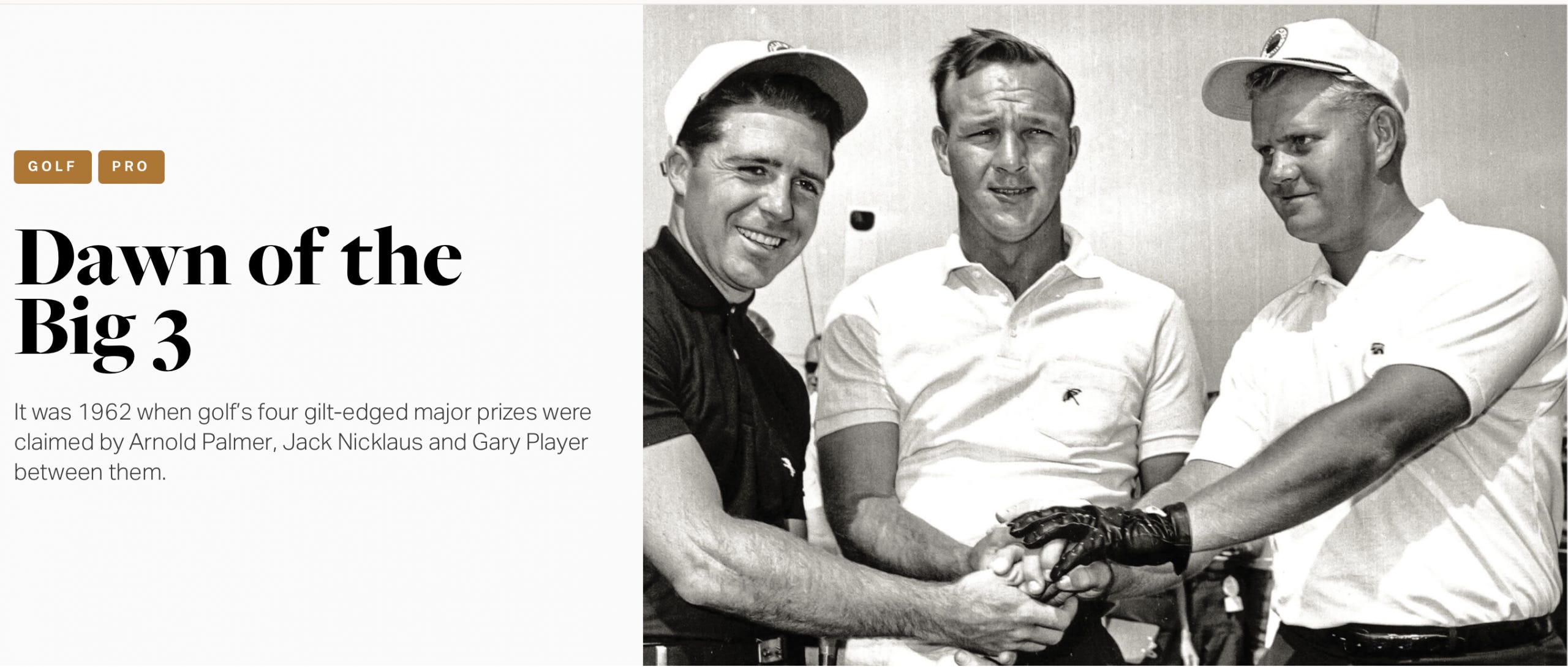
Be honest before answering.
Sport confuses who now dictates its future.
That’s the main lesson of LIV. It isn’t really a story of sportwashing, prize money, formats, or revenue models.
It’s a lesson in power, that our industry still refuses to see.
Many of the most impactful chapters in our history books tell the simple story of certain people thinking that they had the inherited right to govern, when in fact they were on the cusp of a very rude awakening. History doesn’t repeat, but it always rhymes, and the narrative plot is always the same; for the likes of the Romanovs, Marie Antoniette, the British with George Washington, the Shah of Iran, the Savoia royal family in Italy.
Entitled complacency ends with the incumbents first putting their heads in the sand, and then in the guillotine.
Sport’s current governors, the fat cats, the old farts, the oft-corrupt grifters, actually still believe that they lead and dictate our industry. They just don’t.
If it wasn’t so serious, it would be really funny.
I’m the captain now!
This delusion is sport’s version of the Maginot Line, and an old theme for these Columns.
Like the Maginot Line, the governing bodies are now actually obsolete. Useless.
These people haven’t yet realised that, in the 2020s, they control very little about their sport.
The players now do!!
Closely followed by those who provide the money for the whole shebang, (investors, broadcasters and sponsors), and of course the paying fans.
The era of the sport fat cat ended with the arrival of LIV. That was the moment. And for this alone, we should applaud the Saudis. Because, similarly now, the future of other sports depends solely on how many of the top players commit to new rugby and padel leagues, to Maverick Carter’s basketball Tour. And, most obviously, the future of women’s basketball depends almost entirely on how long Caitlin Clark decides to put up with racism and jealousy.
One gets the picture hopefully. The players decide. There is a new captain.
To continue reading this article, please click here:
If you like this work, find out more about the Albachiara content, across the AreYouNotEntertained? Podcast, and the industry book 👇.

Embark on a gripping journey through the intertwined worlds of sports, media, and finance in "Sport's Perfect Storm."
Authored by Roger Mitchell, this illuminating book unveils the challenges these industries face amidst a hurricane of change. Learn how to navigate the turbulent seas of uncertainty, ensuring not just survival but sustainable success.
This book is recommended reading for those starting out, as well as also being a serious manual for experienced corporate finance people, especially those looking to invest in sport.
To secure your Limited Edition copy now, unveil hidden risks, and sail towards a future of informed decision-making, click below 👇